-
 play_arrow
The Lost 45s with Barry Scott Demo!
-
play_arrow
The Lost 45s Sample!
music_noteAmerica’s Largest 70s & 80s Classic Hits Music and Interview Library!


7/1/26-Victor Willis/Village People Cop Dies
Trusted Source: The New York Times at nytimes.com
By Alex Marshall and Isabella Kwai
July 1, 2026 -Updated 8:53 a.m. ET
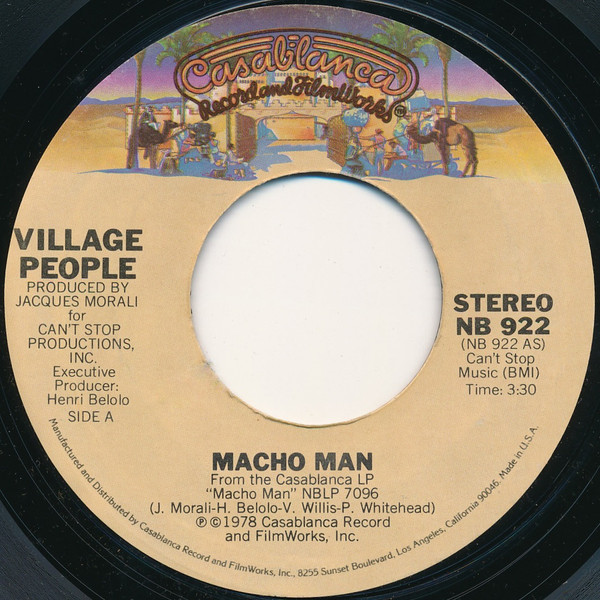
Victor Willis, the lead singer of the Village People who also co-wrote many of the group’s high-camp disco-era hits, including “Y.M.C.A.” and “Macho Man,” died on Monday. He was 74.
The group announced his death in a statement posted to social media that said the cause was “a short but aggressive illness.” No further details were provided.
The Village People became global stars in the 1970s by singing in the garb of sexualized male stereotypes, with Mr. Willis often wearing the helmet and uniform of a police officer or performing dressed as a naval officer.
The critic John Rockwell, reviewing one of the group’s performances for The New York Times in 1979, described Mr. Willis as the only “overt musician” in the group — bringing, Mr. Rockwell said, “a husky gospel fervor” to the high-energy numbers.
The Village People had widespread popular success in the late 1970s, with “Y.M.C.A.” reaching No. 2 on the Billboard singles chart and “In the Navy” hitting No. 3.
More recently, Mr. Willis become a polarizing figure because of his association with President Trump, who regularly plays the group’s music at his rallies — “Y.M.C.A.” became a classic Trump finale — and has appeared onstage dancing with the band.
On Wednesday, Mr. Trump posted a tribute to Mr. Willis on social media. “He was a great and happy guy who loved that I used his group’s song, YMCA, at my Rallies,” Mr. Trump said..
“We will think of Victor every time YMCA is played, like today, and all throughout this July Fourth Birthday week,” he added.
Last year, Mr. Willis wrote at length on social media to explain why the band had agreed to perform at an event that was part of Mr. Trump’s second inauguration. It was not an endorsement of Mr. Trump’s policies, Mr. Willis wrote, “no matter what you say to the contrary.”
He added that the group’s members believed that music should be shared across the political spectrum “and not preserved for one political side.” In May, Mr. Willis and the Village People sang “Happy Birthday” and “Y.M.C.A.” for Secretary of State Marco Rubio during an event in India.
By then, Mr. Willis was the only original member of the Village People still performing with the group, which has cycled through many different lineups. For many years, Mr. Willis was not part of the group and was involved in legal proceedings aimed at securing royalties for his contribution to its hits.
In 2024, Mr. Willis also made headlines when he threatened to sue media outlets that described “Y.M.C.A.” as a gay anthem. He wrote on social media that he didn’t mind gay people adopting the song (the lyrics of which include a call to “hang out with all the boys”). However, he added, he held the news media to a higher standard.
When he wrote the song, Mr. Willis wrote, he had no knowledge of any gay activity at Y.M.C.A. establishments. In a 1979 interview with Rolling Stone, he said the group had “never performed gay.”
“The group performs a masculine show,” Mr. Willis added. “Gay people like us, straight people like us. But we’re not a gay group.
Outside of its use at Trump rallies, where it inevitably spurs the president to his clenched-fists-pumping style of dancing, “Y.M.C.A.” has long been a cultural touchstone, a favorite at weddings and karaoke. In 2020, it was added to the National Recording Registry of the Library of Congress.
Victor Edward Willis was born on July 1, 1951, in Texas and grew up in the Haight-Ashbury neighborhood of San Francisco. His father was a Baptist minister, and Mr. Willis’s earliest involvement with music included singing gospel songs at his father’s church.
As a teenager, he performed with a band called the Ballads and opened for the Temptations at the Fillmore Auditorium in San Francisco. “I was 15 and it was exciting,” Mr. Willis told The San Diego Union-Tribune in 2015.
“It was a glimpse of what was to be,” he added.
Later, Mr. Willis moved to New York, where he performed in productions including “The Wiz” and “The River Niger,” and frequented a Y.M.C.A. on West 63rd Street close to the Empire Hotel, where he lived. That helped inspire the lyrics to “Y.M.C.A.”
“I imagined somebody coming in town and, you know, maybe having blown all their money,” Mr. Willis said in a 2020 interview with the Library of Congress about the song.
The lyrics begin with a call to a depressed young man to “pick yourself off the ground” and head to the Y.M.C.A. for a good time. Mr. Willis said that he pictured the new arrival “just sitting there not knowing which way to go with their life.”
“So that was the first line,” he added.
Mr. Willis may have been the Village People’s frontman, but the band was the idea of Jacques Morali, a composer, and Henri Belolo, a music executive. In 1977, the two men were at a gay club in the West Village neighborhood of New York when they noticed a bartender dressed in an outfit resembling a Native American and another dressed as a cowboy. Soon, they decided to create a disco band featuring singers dressed as American male archetypes.
Mr. Morali and Mr. Belolo met Mr. Willis when the arranger who was working with them on another of their projects suggested bringing in Mr. Willis for backing vocals, according to the Village People’s official biography. Afterward, Mr. Morali told Mr. Willis that he had “had a dream that you sang lead vocals on an album I produced and it went very, very big,” and asked him to front the group that would become the Village People.
The band debuted in 1977 with a self-titled four-track album and went on to have numerous hits. Mr. Willis left in 1980 and did not appear in the group’s flop movie released that year, “Can’t Stop the Music.” He later returned, but left again in 1983.
Mr. Willis married twice. His first marriage, in 1978, was to Phylicia Rashad, the actress known for her starring role on “The Cosby Show.” The couple divorced in 1982. He married Karen Huff-Willis, an attorney and entertainment executive, in 2007. She survives him, but information about his other survivors was not immediately available.
In his 2015 interview with The Union-Tribune, Mr. Willis said he had spent much of the 1980s and 1990s “kind of drugged out because I was disappointed with the way things were and got frustrated, and gave up for a bit.”
In 2015, he released a solo album, “Solo Man,” that he had originally recorded in 1979. Two years later, he returned to the Village People, having secured his share of copyright payments.
In the Union-Tribune interview, Mr. Willis reflected on his long career. “I hope to be remembered as that guy who got out of the music business, but never gave up,” he said, “and came back — came back successfully — and did something for people to smile about.”
Similar posts